From automation to augmentation: How AI reshapes strategic decision-making in knowledge-intensive organizations
Abstract: Artificial intelligence (AI) is increasingly embedded in managerial decision-making, yet its strategic value remains unevenly realized across organizations. While much of the existing literature emphasizes automation and efficiency gains, this conceptual paper shifts the focus to augmentation by examining how AI reshapes strategic decision-making in knowledge-intensive organizations. Rather than replacing human agency, AI can expand cognitive capacity by supporting sensemaking, judgment, and collaborative reasoning under conditions of complexity and uncertainty. Building on research in decision intelligence, human–AI collaboration, leadership, and sensemaking, the paper introduces the AI-Augmented Decision Framework for Leaders. The framework specifies four interrelated leadership capabilities: AI literacy, sensemaking capability, judgment capability, and human–AI collaborative capability. It also explains how these capabilities are enacted across an iterative decision cycle. Illustrative cases from leadership development, higher education, and research and development contexts provide analytical grounding for the framework. The paper contributes to research on AI-augmented decision-making, leadership, and digital transformation by clarifying how leaders translate AI-enabled insights into responsible and actionable strategic decisions.
Keywords: Artificial intelligence, AI-augmented decision-making, leadership capabilities, digital transformation, human–AI collaboration, sensemaking
Author:
Heli Bergström, principal lecturer, South-Eastern Finland University of Applied Sciences, Patteristonkatu 3 D, 50100 Mikkeli, heli.bergstrom@xamk.fi
1. Introduction
Digital transformation has entered a new phase in which artificial intelligence (AI) is no longer primarily understood as a tool for automating routine tasks. Instead, AI increasingly functions as a strategic partner that augments human cognition, reshapes managerial decision-making, and alters leadership roles in knowledge-intensive organizations. While early waves of digitalization focused on efficiency, cost reduction, and process automation, contemporary organizations face challenges that are less technical and more cognitive in nature: complexity, uncertainty, ambiguity, and information overload (Brynjolfsson & McAfee, 2014; Raisch & Krakowski, 2021; Ruokonen & Ritala, 2025).
Despite unprecedented access to data and advanced analytics, many organizations struggle to translate information into high-quality strategic decisions. The paradox of being “data rich but insight poor” remains persistent, indicating that technological capability alone is insufficient for value creation (Davenport & Harris, 2007; George et al., 2014; Salazar & Kunc, 2025). Studies on AI readiness and analytics adoption suggest that organizations frequently overinvest in technical infrastructure while underinvesting in human capabilities such as sensemaking, judgment, and ethical reasoning (Jöhnk et al., 2021; Shrestha et al., 2019; Herath Pathirannehelage et al., 2025). As a result, AI-generated insights often remain underutilized, misunderstood, or misapplied in managerial contexts. At the same time, recent advances in generative AI further reinforce the shift from automation to augmentation, highlighting how AI systems increasingly support ideation, sensemaking, and knowledge work rather than routine task execution (Brynjolfsson et al., 2025; Mariani & Dwivedi, 2024; Woolley, 2024).
Existing literature on AI in management has predominantly emphasized automation effects, operational efficiency, and performance outcomes (Autor, 2015; Brynjolfsson et al., 2017; Csaszar et al., 2024). While these contributions are valuable, they offer a limited understanding of how AI transforms the cognitive work of leaders. In particular, the question of how AI augments rather than replaces managerial decision-making remains underexplored. Recent studies on human–AI collaboration and decision intelligence suggest that AI’s most significant impact may lie in supporting human sensemaking and expanding the range of considered alternatives (Herath Pathirannehelage et al., 2025). At the same time, explainable AI research indicates that AI systems can shape how decision-makers interpret and evaluate reasoning processes, without automatically improving decision quality (Faraj et al., 2018; Alufaisan et al., 2021). However, these insights have yet to be integrated into a coherent framework that clarifies what kinds of leadership capabilities are required in AI-rich environments.
This paper addresses this gap by shifting the analytical focus from automation to augmentation. It examines how AI reshapes strategic decision-making in knowledge-intensive organizations by enabling new forms of human–AI collaboration. The central argument is that AI does not improve decision quality by replacing human judgment, but by augmenting it, provided that leaders possess the capabilities needed to interpret, contextualize, and critically evaluate AI-generated insights. Consequently, the effective use of AI becomes a leadership and organizational challenge rather than a purely technological one.
The paper is guided by the following research questions:
- How does AI augment managerial decision-making in knowledge-intensive organizations?
- What leadership capabilities are required to enable effective human–AI collaboration in strategic decision-making?
To address these questions, the paper makes three key contributions to emerging research on AI-augmented decision-making and leadership. First, it integrates insights from research on AI augmentation and managerial decision-making, which has emphasized human–AI complementarity, decision process design, and the limits of fully automated strategic judgment (Raisch & Krakowski, 2021; Shrestha et al., 2019; Herath Pathirannehelage et al., 2025; Guthrie et al., 2025). Based on this synthesis, the paper develops the AI-Augmented Decision Framework for Leaders, which identifies four complementary leadership capabilities: AI literacy, sensemaking capability, judgment capability, and human–AI collaborative capability. Second, the paper connects this framework to recent work showing that AI increasingly reshapes strategic work through cognitive support, scenario exploration, and the reconfiguration of managerial roles rather than through simple substitution of human labor (Csaszar et al., 2024; Ruokonen & Ritala, 2025; Albashrawi, 2025; Bevilacqua et al., 2026). Third, the paper contributes to leadership and digital transformation research by clarifying how effective AI use depends not only on adoption or analytics infrastructure, but also on leaders’ interpretive, ethical, and collaborative capabilities in knowledge-intensive settings (Faraj et al., 2018; Jöhnk et al., 2021; Sacavém et al., 2026). Unlike prior studies that tend to focus either on technological adoption, decision intelligence architectures, or isolated leadership competencies (e.g., McAfee & Brynjolfsson, 2012; Davenport, 2018; Long & Magerko, 2020; Jöhnk et al., 2021), this paper brings these streams together into a capability-based framework that explains how AI augments strategic decision-making in practice.
This paper adopts a theory-building approach that combines conceptual integration with theory-informed illustrative cases. Rather than aiming at statistical generalization, the purpose is analytical clarification: the cases are used to surface mechanisms, recurring patterns, and boundary conditions of AI-augmented decision-making across different knowledge-intensive settings. The illustrative cases were selected based on three criteria: (1) high knowledge intensity, (2) strategic decision-making under conditions of uncertainty and ambiguity, and (3) the active use of AI as a cognitive support tool in decision processes. The cases span leadership coaching, master’s-level business education, and research and development (RDI) contexts to ensure variation across settings while maintaining theoretical relevance. This approach supports the development of the AI-Augmented Decision Framework for Leaders by showing how recurring patterns of human–AI collaboration and leadership capability formation become visible across contexts.
The remainder of the paper is structured as follows. Section 2 reviews relevant literature on AI in managerial work, leadership capabilities in digital environments, and challenges related to AI-augmented decision-making. Section 3 introduces the AI-Augmented Decision Framework and elaborates its core capabilities and iterative decision cycle. Section 4 presents illustrative cases that ground the framework in practice. Section 5 discusses theoretical and practical implications for leadership development and organizational design. Finally, Section 6 concludes the paper by summarizing contributions, outlining limitations, and suggesting directions for future research.
2. Literature review
2.1 AI in managerial work: From automation to augmentation
Research on artificial intelligence in managerial work has evolved alongside broader waves of digital transformation. Early studies primarily conceptualized AI as a means of automation, replacing or optimizing human labor in routine, rule-based tasks (Autor, 2015; Brynjolfsson & McAfee, 2014). From this perspective, AI-driven systems were expected to increase efficiency, reduce costs, and improve consistency in organizational processes. Management research during this phase focused largely on productivity gains, algorithmic decision-making, and substitution effects.
More recent scholarship has shifted attention from substitution toward augmentation. Rather than replacing managers, AI is increasingly viewed as a cognitive tool that supports human reasoning, expands analytical capacity, and can enhance decision quality (Raisch & Krakowski, 2021; Csaszar et al., 2024). This perspective aligns with the concept of decision intelligence, which emphasizes the integration of data, analytics, and human judgment into coherent decision-making processes (Davenport, 2018; Herath Pathirannehelage et al., 2025). Decision intelligence frameworks highlight that decisions are not merely analytical outputs, but socio-cognitive processes shaped by interpretation, context, and values.
Human–AI teaming research further reinforces this shift. Studies suggest that AI systems perform best when embedded in collaborative arrangements where humans remain actively involved in framing problems, validating outputs, and making final judgments (Faraj et al., 2018; Shrestha et al., 2019). In such arrangements, AI contributes speed, pattern recognition, and scenario exploration, while humans contribute contextual understanding, ethical reasoning, and accountability. Importantly, this line of research implies that AI’s value often emerges not from autonomy but from interdependence between human and artificial agents.
The distinction between automation and augmentation is particularly relevant in knowledge-intensive organizations, where tasks are ill-structured, goals are ambiguous, and outcomes are uncertain. In these contexts, fully automated decision-making is often neither feasible nor desirable (Jarrahi, 2018). Instead, AI can function as a sensemaking support, helping managers explore alternatives, surface assumptions, and reflect on complex trade-offs. Despite these insights, the literature still lacks integrative models that connect AI’s cognitive affordances with the leadership capabilities required for effective use – an omission this paper seeks to address.
Recent research further strengthens the augmentation perspective. Empirical and review-based studies published in 2025–2026 suggest that AI’s contribution to managerial and strategic work is increasingly realized through complementarity rather than substitution: AI can accelerate decision speed, widen the range of alternatives considered, and support scenario exploration, but these benefits depend on complementary organizational and leadership capabilities (Guthrie et al., 2025; Albashrawi, 2025; Bevilacqua et al., 2026). This emerging body of work also indicates that the managerial challenge is no longer merely whether AI is adopted, but how it is embedded into strategic work in ways that preserve human agency, judgment, and accountability.
2.2 Leadership capabilities in digital and AI-rich environments
Leadership research has long emphasized that effective decision-making depends on more than access to information. Sensemaking theory highlights that leaders must interpret ambiguous cues, construct shared meaning, and guide action under uncertainty (Weick, 1995; Maitlis & Christianson, 2014). In digital environments characterized by data abundance and rapid change, sensemaking becomes even more critical, as leaders must navigate competing signals and incomplete information.
Digital transformation also intensifies the cognitive demands placed on leaders. Rather than reducing complexity, advanced technologies often increase it by generating more data, faster feedback loops, and greater interdependence between decisions (George et al., 2014). As a result, leadership capabilities such as framing problems, questioning assumptions, and integrating multiple perspectives become increasingly important. AI does not eliminate these requirements; instead, it amplifies the need for them.
A growing body of literature emphasizes digital literacy and AI literacy as foundational leadership competencies. AI literacy refers not to technical programming skills, but to an understanding of how AI systems function, what their limitations are, and how their outputs should be interpreted (Long & Magerko, 2020; Jöhnk et al., 2021). Leaders lacking such literacy may either overtrust AI outputs or dismiss them entirely—both of which can undermine decision quality.
In addition to literacy, judgment capability remains central. Judgment involves evaluating evidence, balancing competing goals, and making value-laden choices that cannot be delegated to algorithms (Mintzberg, 2009). Ethical judgment is particularly salient in AI-augmented decision-making, as algorithmic systems may embed biases, obscure accountability, or produce recommendations that conflict with organizational values (Floridi et al., 2018).
Consequently, leadership in AI-rich environments requires the ability to critically evaluate AI-enabled insights rather than accept them at face value.
Together, these strands of literature suggest that leadership capabilities in digital contexts are not replaced by AI but reconfigured. Leaders must combine technological understanding with interpretive, ethical, and relational skills. However, existing research often discusses these capabilities in isolation, without explicitly linking them to AI-supported decision-making processes. This gap points to the need for an integrative framework that connects leadership capabilities directly to human–AI collaboration.
Recent leadership research also points in the same direction. A systematic review by Sacavém et al. (2026) highlights that AI-driven leadership is increasingly discussed through decision-making competencies, ethical challenges, and changing managerial roles, while Bevilacqua et al. (2026) show that top managers require interdependent AI-related skills that extend beyond technical understanding toward strategic co-thinking, multi-level coordination, and ethics-oriented risk management. Together, these studies reinforce the argument that leadership in AI-rich environments should be conceptualized as a capability bundle rather than as a set of isolated digital skills.
2.3 Challenges in AI-augmented decision-making
Despite its potential, AI-augmented decision-making presents significant challenges that limit its effectiveness in practice. One widely discussed issue is the risk of overtrust or undertrust in AI systems. Overtrust occurs when decision-makers rely excessively on algorithmic outputs without sufficient critical evaluation, while undertrust leads to the dismissal of potentially valuable insights (Dietvorst et al., 2015; Logg et al., 2019). Both phenomena are often linked to an insufficient understanding of AI systems and their limitations.
A second challenge concerns interpretation and strategic relevance. AI systems generate outputs based on patterns in historical data, yet managerial decisions frequently require forward-looking judgment and contextual sensitivity. When analytical outputs are treated as inherently authoritative, organizations risk mistaking analytical precision for strategic relevance (Tsoukas, 2009). Explainable AI does not automatically resolve this problem: explanations can shape user trust and reliance, sometimes increasing misplaced confidence if outputs are not critically assessed (Alufaisan et al., 2021).
Organizational readiness also plays a critical role. Studies on AI adoption indicate that cultural factors, such as openness to experimentation, psychological safety, and cross-functional collaboration, significantly influence whether AI insights are used effectively (Schein, 2010; Jöhnk et al., 2021; Ruokonen & Ritala, 2025). In hierarchical or siloed organizations, AI may reinforce existing power structures rather than improve decision quality. Furthermore, unclear accountability structures can lead to ambiguity about who is responsible for decisions supported by AI systems.
Finally, ethical and governance challenges remain prominent. Issues related to transparency, explainability, and responsibility complicate the integration of AI into managerial decision-making (Floridi et al., 2018). Leaders must navigate tensions between efficiency and accountability, particularly when AI systems influence high-stakes strategic choices. These challenges underscore that AI-augmented decision-making is not merely a technical implementation issue but a socio-organizational transformation. Recent work on generative AI and strategic management similarly suggests that AI creates value only when organizations establish routines for critical interpretation, governance, and role redesign, rather than treating AI outputs as self-sufficient decision solutions (Ruokonen & Ritala, 2025; Albashrawi, 2025).
In summary, the literature highlights both the promise and the limitations of AI in managerial decision-making. While AI offers significant potential for cognitive augmentation, its effective use depends on leadership capabilities, organizational context, and ethical governance. However, existing research lacks a coherent framework that brings these elements together. The next section addresses this gap by introducing the AI-Augmented Decision Framework for Leaders, which integrates insights from decision intelligence, sensemaking, and leadership research.
3. The AI-Augmented Decision Framework for Leaders
3.1 Core capabilities and their reinforcing interactions
Building on the literature reviewed above, the AI-Augmented Decision Framework for Leaders conceptualizes strategic decision-making as a socio-cognitive and socio-technical process in which AI contributes analytical speed, pattern recognition, and generative exploration, while leaders contribute interpretation, contextualization, ethical evaluation, and accountability. The framework responds directly to three gaps identified in prior literature. First, research on AI in managerial work has explained why augmentation matters but has offered limited specification of the leadership capabilities through which augmentation occurs (Raisch & Krakowski, 2021; Csaszar et al., 2024; Herath Pathirannehelage et al., 2025). Second, studies on leadership in digital and AI-rich environments have identified relevant competencies yet often discuss them separately rather than as an integrated capability system (Long & Magerko, 2020; Jöhnk et al., 2021; Sacavém et al., 2026; Bevilacqua et al., 2026). Third, research on AI-augmented decision-making has highlighted trust, explainability, and governance challenges without sufficiently clarifying how leaders should work with AI across the phases of an actual decision process (Shrestha et al., 2019; Alufaisan et al., 2021; Ruokonen & Ritala, 2025; Albashrawi, 2025). The framework addresses these gaps by linking AI-enabled analytical affordances to four interdependent leadership capabilities and by showing how these capabilities are enacted across an iterative decision cycle. Figure 1 highlights both the reciprocal reinforcement among the four capabilities and their differential salience across the phases of an iterative AI-augmented decision cycle.
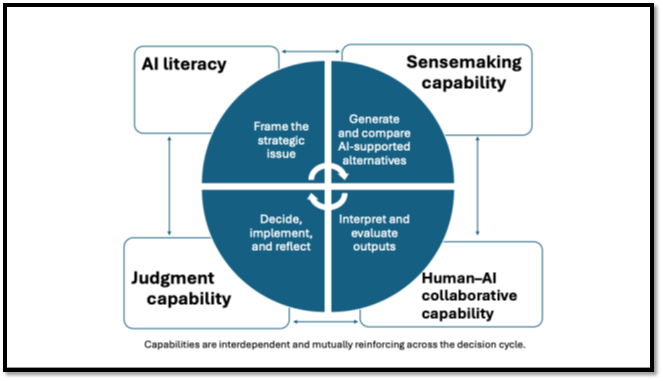
Figure 1. The AI-Augmented Decision Framework for Leaders: Four interdependent leadership capabilities enacted across an iterative decision cycle
The framework consists of four interrelated leadership capabilities that enable effective AI-augmented decision-making: AI literacy, sensemaking capability, judgment capability, and human–AI collaborative capability. These capabilities should not be understood as parallel attributes that simply coexist. Rather, they reinforce or weaken one another during the decision process. AI literacy shapes whether leaders can interpret the epistemic status of AI outputs in the first place: what kind of output is being produced, on what basis, with what limitations, and with what degree of uncertainty. This, in turn, affects sensemaking capability, because contextual interpretation becomes shallow if leaders do not understand how the output was generated or what may be missing from it. Sensemaking then conditions judgment capability by determining which alternatives are treated as strategically relevant, ethically acceptable, or worthy of further scrutiny. Human–AI collaborative capability cuts across these processes by shaping how AI is positioned in practice: as a source of prompts for reflection, as a generator of alternatives, or as a prematurely authoritative answer. A weakness in any one capability can therefore reduce the value of the others. For example, high AI literacy without sensemaking may produce technically informed but strategically detached analysis; strong sensemaking without judgment may generate rich interpretations without accountable choices; judgment without collaborative capability may collapse human–AI interaction into either algorithmic deference or outright rejection. Dynamic reinforcement thus refers to reciprocal enablement: each capability improves the quality with which the others can be enacted, while repeated use across decision episodes can strengthen the overall capability system over time.
AI literacy refers to leaders’ understanding of how AI systems function, including their underlying logic, data dependencies, limitations, and sources of uncertainty. Importantly, AI literacy does not imply technical expertise in algorithm development. Instead, it involves the ability to ask informed questions, interpret outputs appropriately, and recognize situations in which AI-generated insights may be unreliable or incomplete (Long & Magerko, 2020; Jöhnk et al., 2021). Without sufficient AI literacy, leaders risk either overtrust in algorithmic recommendations or premature rejection of potentially valuable insights.
Sensemaking capability captures leaders’ ability to interpret ambiguous situations, frame strategic problems, and construct shared understanding around AI-enabled insights. Drawing on sensemaking theory (Weick, 1995; Maitlis & Christianson, 2014), the framework emphasizes that AI does not reduce ambiguity by itself. Instead, AI can increase the volume and complexity of available information, making interpretive work more – not less – important. Leaders must actively contextualize AI outputs, connect them to organizational goals, and facilitate dialogue around their meaning. In this sense, AI functions as an input to sensemaking rather than a substitute for it.
Judgment capability refers to leaders’ capacity to evaluate AI-enabled insights through experience, values, and ethical reasoning. Strategic decisions often involve trade-offs, moral considerations, and long-term consequences that cannot be resolved through data alone (Mintzberg, 2009). Judgment capability enables leaders to assess the relevance, plausibility, and implications of AI-generated recommendations and to assume responsibility for final decisions. This capability is particularly critical in situations where AI outputs conflict with organizational values or stakeholder expectations.
Human–AI collaborative capability reflects leaders’ ability to work productively with AI systems as cognitive partners. This includes designing decision processes that integrate AI at appropriate stages, encouraging critical engagement rather than passive acceptance, and fostering psychological safety in discussing AI-enabled insights. Effective collaboration requires leaders to position AI as a tool for exploration and reflection, not as an authority that closes discussion. This capability also encompasses the social dimension of AI use, as leaders must help teams interpret and calibrate trust in AI outputs while maintaining human accountability.
Together, these four capabilities define AI-augmented decision-making as a leadership practice rather than a technological function. The framework suggests that AI can enhance decision quality when leaders actively integrate analytical outputs with human interpretation, judgment, and ethical reflection. Conversely, the absence of these capabilities limits AI’s strategic value, regardless of technical sophistication.
3.2 Capabilities across the AI-augmented decision cycle
The framework can also be read as an iterative decision cycle consisting of four phases: (1) framing the strategic issue, (2) generating and comparing AI-augmented alternatives, (3) interpreting and evaluating outputs, and (4) deciding, implementing, and reflecting. The purpose of this cycle is not to impose a rigid sequence, but to make visible where and how the four leadership capabilities are enacted.
In the first phase, framing the strategic issue, AI literacy and sensemaking capability are especially critical. Leaders must formulate the problem, determine what kinds of data, prompts, and contextual inputs are relevant, and recognize what aspects of the decision cannot be meaningfully captured by AI. In the second phase, generating and comparing AI-augmented alternatives, AI literacy and human–AI collaborative capability become central, because leaders must interact with AI iteratively, refine prompts, and prevent the narrowing of options through uncritical acceptance of early outputs. In the third phase, interpreting and evaluating outputs, sensemaking and judgment capability come to the foreground as leaders assess plausibility, strategic fit, stakeholder implications, and ethical tensions. In the fourth phase, deciding, implementing, and reflecting, judgment capability and human–AI collaborative capability remain critical, as leaders assume responsibility for the final choice, communicate the rationale, and build feedback loops through which the organization learns from the outcome.
Reading the framework through this decision cycle clarifies that AI augmentation is not a one-off analytical intervention but a repeated pattern of interaction in which leadership capabilities shape the quality of both the process and its outcomes. For this reason, the framework should be understood dynamically: weaknesses in earlier phases tend to propagate downstream, whereas reflective learning after implementation can strengthen subsequent rounds of framing, interaction, and evaluation.
4. Illustrative cases: Analytical grounding for AI-augmented decision-making
The cases presented in this section are theory-informed illustrative cases rather than formal empirical case studies. Their purpose is analytical: to make visible how the proposed framework operates across different knowledge-intensive settings, not to test causal relationships or provide statistical generalization. This use of illustrative cases is consistent with recent guidance on conceptual and theory-building research, which emphasizes the need to make theoretical mechanisms explicit, justify case selection carefully, and show how a proposed framework gains analytical relevance across contexts (Lim, 2026; Kibler et al., 2025; Bouncken et al., 2026). Accordingly, the cases are used here to clarify recurring mechanisms and practical boundary conditions of AI-augmented decision-making rather than to claim representativeness.
The illustrative analysis proceeded abductively. First, relevant decision episodes were identified from documented teaching, coaching, and development situations in which AI had been used to support problem framing, alternative generation, interpretation, or evaluation. Second, these episodes were anonymized and, where necessary, written as composite cases to protect individuals and organizations while preserving the decision logic of the situations. Third, the cases were analyzed through the lens of the proposed framework by examining how AI literacy, sensemaking capability, judgment capability, and human–AI collaborative capability became visible in each case and how these capabilities interacted across the decision process. The aim was not to code frequency or produce exhaustive thematic categories, but to use theoretically informed comparison to surface recurring mechanisms and boundary conditions.
4.1 Leadership coaching and decision-making micro-scenarios
The first set of cases originates from leadership coaching contexts where managers engage with AI-enabled decision-making micro-scenarios. In these scenarios, leaders are presented with strategically ambiguous situations, such as competing investment priorities, organizational restructuring options, or stakeholder conflicts, and use AI tools to explore alternative courses of action.
AI is employed to generate scenario variants, surface potential risks, and articulate implicit assumptions embedded in different decision paths. Rather than producing a single “optimal” solution, the AI functions as a cognitive amplifier, expanding the decision space and making trade-offs more visible. Leaders interact iteratively with the AI, refining prompts, questioning outputs, and adjusting parameters based on contextual knowledge and organizational constraints.
These cases highlight the importance of AI literacy, as leaders must understand how prompts shape outputs and recognize the limitations of AI-generated scenarios. Sensemaking capability becomes central when leaders interpret AI outputs in light of organizational culture, strategic priorities, and stakeholder dynamics. Judgment capability is exercised when leaders evaluate which scenarios are plausible, acceptable, or ethically defensible. Finally, human–AI collaborative capability emerges as leaders learn to use AI not as an authority but as a conversational partner that supports reflective thinking.
The cases suggest that AI can enhance decision quality most effectively when leaders remain actively engaged in interpreting and challenging AI-generated insights. Passive acceptance of outputs, by contrast, tends to reduce learning and obscure accountability. In framework terms, the value created in these scenarios depends on leaders’ ability to combine AI literacy (to interrogate the tool), sensemaking (to frame the dilemma), judgment (to select an ethically and strategically defensible path), and human–AI collaborative capability (to keep AI as a support for dialogue rather than a decision authority).
In terms of the decision cycle, these coaching cases foreground the first three phases – framing the issue, generating alternatives, and interpreting outputs – while also showing that final responsibility remains with the leader in the decision and reflection phase.
4.2 AI-enabled sensemaking in master’s-level business education
The second set of cases comes from master’s-level business education, where AI tools are integrated into courses focused on leadership, strategy, and decision-making. In these settings, students use AI to support sensemaking tasks such as analyzing complex cases, exploring strategic options, and reflecting on managerial dilemmas.
AI is introduced explicitly as a co-thinking partner rather than a source of correct answers. Students are guided to use AI to generate alternative interpretations, identify blind spots, and articulate reasoning processes. Teaching design emphasizes critical engagement: students must justify how AI outputs informed their thinking and where they chose to deviate from algorithmic suggestions. In addition, course structures encourage students to document prompt design and to reflect on how different framings produce different outputs.
These cases illustrate how AI can scaffold cognitive processes without diminishing human agency. Sensemaking capability is strengthened as students learn to frame problems more precisely and integrate multiple perspectives. Judgment capability is developed through reflective assignments that require ethical evaluation and contextual reasoning. Importantly, the role of the educator shifts from content delivery to facilitating interpretation and evaluation, reinforcing the view that AI reshapes, not replaces, human roles.
The educational cases also reveal the risks of insufficient guidance. When AI is introduced without clear expectations or reflective structure, students may either over-rely on AI outputs or disengage critically. From the framework perspective, these outcomes underscore the joint importance of AI literacy (understanding tool limitations), sensemaking (framing and interpreting outputs), judgment (evaluating quality and implications), and collaborative capability (using AI to support dialogue, critique, and shared learning rather than shortcutting thinking).
From the perspective of the framework, these educational cases are particularly useful for showing how capabilities can be developed pedagogically across the full decision cycle, especially through explicit reflection on framing, prompting, interpretation, and justified deviation from AI suggestions.
4.3 AI-augmented strategic sensemaking in RDI and development projects
The third set of cases draws from research, development, and innovation (RDI) projects in which multidisciplinary teams engage in strategic planning and organizational development. In these projects, AI tools are used to synthesize large volumes of qualitative and quantitative data, identify emerging patterns, and support strategic discussions among stakeholders.
AI-enabled analyses are used as inputs to collective sensemaking workshops rather than as standalone decision aids. Teams review AI-generated insights together, discuss their implications, and assess their relevance to organizational goals and constraints. This collective engagement helps surface assumptions, align interpretations, and build shared understanding across disciplines and stakeholder groups.
These cases emphasize human–AI collaborative capability at the organizational level. Leaders play a critical role in structuring interaction around AI outputs, ensuring that insights are debated rather than accepted uncritically. Judgment capability is particularly salient when AI-generated patterns conflict with experiential knowledge or stakeholder expectations. Leaders must navigate tensions between analytical evidence and practical feasibility while maintaining transparency and accountability.
Across these projects, AI proves most valuable when embedded in iterative, dialogical decision processes. When AI outputs are treated as final recommendations rather than discussion triggers, their strategic value diminishes. In framework terms, AI literacy shapes the team’s ability to assess the credibility and limits of synthesis outputs, sensemaking enables shared interpretation of patterns, judgment guides decisions under constraints, and collaborative capability ensures that AI remains a resource for collective reasoning rather than a substitute for it.
These RDI cases illustrate most clearly that the final phase of the decision cycle – deciding, implementing, and reflecting – cannot be separated from collaborative interpretation, because the value of AI-generated synthesis emerges only when stakeholders collectively assess its relevance, feasibility, and consequences.
4.4 Cross-case insights
Across the illustrative cases, several consistent patterns emerge. First, AI augments decision-making primarily by expanding cognitive capacity – broadening the range of alternatives considered, accelerating exploration of scenarios, and making assumptions more visible – rather than by delivering definitive answers. The cases suggest that AI’s most productive role is often to function as a cognitive surface for exploration: a medium through which leaders and teams externalize reasoning, test interpretations, and articulate trade-offs.
Second, the cases demonstrate that leadership capabilities strongly mediate AI’s impact. Without sufficient AI literacy, decision-makers may overestimate the reliability of outputs, misinterpret system limitations, or fail to recognize how prompt design and data dependencies shape recommendations. Without sensemaking capability, AI outputs risk being treated as detached “facts” rather than inputs that require contextual interpretation. Without judgment capability, decision processes may prioritize apparent analytical precision over ethical defensibility and strategic relevance. Finally, without human–AI collaborative capability, organizations may incorporate AI in ways that close dialogue, reduce critical engagement, and blur accountability.
Third, the cases highlight that effective human–AI collaboration depends on deliberate process design that encourages interpretation, dialogue, and ethical reflection. Across contexts, AI created most value when embedded in iterative cycles: framing the question, generating alternatives, interpreting outputs collaboratively, making a responsible choice, and reflecting on implications. In contrast, value diminished when AI use was positioned as an end point rather than a support for ongoing reasoning.
Fourth, the cases suggest two practical boundary conditions for AI augmentation. (1) High ambiguity and knowledge intensity increase the potential value of AI as a sensemaking support but also increase the risks of misinterpretation and overconfidence. (2) Low psychological safety or weak governance can undermine AI augmentation by discouraging critical questioning and leaving responsibility unclear. These boundary conditions reinforce the paper’s core claim: AI-augmented decision-making is not merely a technological achievement, but a leadership practice embedded in organizational culture and decision routines.
Together, these cases provide analytical grounding for the AI-Augmented Decision Framework and illustrate how its components operate in organizational and educational contexts. They also clarify why the framework’s four capabilities should be treated as mutually reinforcing: the absence of any one capability can weaken the entire decision process, whereas their alignment enables AI to function as a genuine augmentation of strategic decision-making. While the cases are illustrative, the recurrence of similar patterns across different contexts increases the analytical robustness of the framework and supports its relevance for knowledge-intensive environments.
5. Discussion
This paper examined how artificial intelligence reshapes strategic decision-making in knowledge-intensive organizations by shifting the focus from automation toward cognitive augmentation. Drawing on prior literature and illustrative cases, the analysis suggests that AI’s strategic value lies not in replacing managerial judgment but in transforming how decisions are constructed, interpreted, and evaluated. In line with research arguing that AI often produces value through human–AI interdependence rather than autonomy, the discussion below elaborates the theoretical and practical implications of AI-augmented decision-making for leadership and organizations (Faraj et al., 2018; Raisch & Krakowski, 2021).
5.1 Positioning the framework in relation to prior research
The AI-Augmented Decision Framework should be understood as an integrative framework rather than a competing replacement for existing models. Compared with decision intelligence research, it places greater emphasis on the leadership capabilities required to translate AI-enabled analysis into contextually grounded and responsible action. Compared with human–AI teaming research, it specifies more clearly what leaders contribute cognitively and relationally when AI becomes part of strategic decision processes. Compared with leadership research in digital contexts, it treats AI not merely as background infrastructure but as an active element in the decision environment that reshapes interpretation, timing, and accountability. In this way, the framework contributes to the automation–augmentation debate not by treating augmentation as a general outcome, but by specifying the capability bundle through which augmentation becomes possible in practice.
5.2 AI as a catalyst for reconfiguring managerial roles
The findings reinforce the view that AI changes the nature of managerial work rather than eliminating it. Consistent with the automation–augmentation paradox, AI shifts managerial effort away from routine analysis toward framing, interpretation, and oversight of decision processes (Raisch & Krakowski, 2021). Across the illustrative cases, leaders increasingly act as curators, interpreters, and ethical evaluators of AI-augmented decisions – roles that emphasize sensemaking and accountability rather than being the primary source of answers (Faraj et al., 2018; Maitlis & Christianson, 2014; Weick, 1995).
This role reconfiguration challenges traditional leadership assumptions that emphasize individual expertise and hierarchical authority. AI-enabled decision-making redistributes cognitive labor across humans and technologies, requiring leaders to orchestrate decision processes rather than dominate them. In practice, leaders must ensure that problem framing remains explicit, that AI outputs are treated as inputs to interpretation rather than definitive conclusions, and that decision rationales remain discussable and contestable. These demands align with sensemaking theory’s emphasis on constructing shared meaning under ambiguity and uncertainty (Weick, 1995; Maitlis & Christianson, 2014). Recent research on AI-augmented decision-making and generative AI strategy similarly emphasizes that organizational value arises from complementarity between human judgment and AI capabilities rather than substitution (Csaszar et al., 2024; Herath Pathirannehelage et al., 2025; Ruokonen & Ritala, 2025).
Importantly, the shift is not purely cognitive but also ethical and governance-related. As AI becomes embedded in high-stakes decisions, leaders must retain responsibility for value-laden trade-offs and for the consequences of decisions that cannot be delegated to algorithms (Mintzberg, 2009). Ethical frameworks for AI further underscore that accountability and transparency remain human obligations, even when analytical inputs are AI-generated (Floridi et al., 2018). In this sense, AI-augmented decision-making elevates leadership requirements: leaders must combine AI literacy and interpretation with ethical judgment and explicit accountability structures.
The AI-Augmented Decision Framework clarifies this reconfiguration by specifying four leadership capabilities – AI literacy, sensemaking capability, judgment capability, and human–AI collaborative capability – that jointly enable responsible AI augmentation. This helps explain why organizations that invest primarily in technology may remain “data rich but insight poor”: without leadership capabilities and supportive routines, AI outputs do not translate into strategic action (Davenport & Harris, 2007; George et al., 2014; Jöhnk et al., 2021).
5.3 Theoretical implications for AI and leadership research
From a theoretical perspective, the paper contributes to three overlapping streams of research. First, it extends research on AI in management by offering a capability-based explanation of augmentation. Whereas prior work often contrasts automation and augmentation as abstract outcomes, this paper specifies how augmentation occurs through distinct but interdependent leadership capabilities. The framework thus adds precision to theorizing about AI’s role in managerial work, particularly in knowledge-intensive contexts where decisions are ill-structured and automation is limited (Jarrahi, 2018; Raisch & Krakowski, 2021).
Second, the paper contributes to leadership research by integrating AI explicitly into sensemaking theory. Classic sensemaking research emphasizes leaders’ role in interpreting equivocal information and guiding action under uncertainty (Weick, 1995; Maitlis & Christianson, 2014). The findings suggest that AI intensifies sensemaking demands by increasing information volume, multiplying plausible interpretations, and accelerating feedback cycles. Leadership effectiveness, therefore, depends increasingly on the ability to integrate AI-enabled analytical outputs into shared understanding, rather than on decisiveness alone.
Third, the framework complements decision intelligence literature by foregrounding the socio-cognitive and ethical character of decision processes. While decision intelligence highlights structured workflows and analytical rigor (Davenport, 2018), this paper argues that decisions remain shaped by context, values, and accountability. AI augments decision-making only when leaders actively engage with outputs, challenge assumptions, and take responsibility for outcomes (Mintzberg, 2009; Floridi et al., 2018). This integration underscores that the strategic impact of AI cannot be inferred from technical performance alone; it depends on leadership practice.
5.4 Practical implications for leadership development and organizations
The findings carry several practical implications for organizations seeking to leverage AI strategically. First, organizations should reconsider how they define AI readiness. Technical infrastructure and data availability are necessary but insufficient. Leadership development should explicitly cultivate AI literacy and interpretive competence, enabling leaders to understand limitations, interrogate outputs, and calibrate reliance. This is consistent with research emphasizing that AI literacy involves interpretive capability rather than programming expertise (Long & Magerko, 2020; Jöhnk et al., 2021). Training leaders merely to “use AI tools” without strengthening judgment and sensemaking risks superficial adoption and misplaced trust (Salazar & Kunc, 2025).
Second, decision-making processes should be deliberately designed to support human–AI collaboration. Rather than embedding AI as an automated recommender, organizations should position AI as a trigger for dialogue, exploration, and reflection, an approach aligned with human–AI teaming research (Faraj et al., 2018; Shrestha et al., 2019). In practice, this means establishing routines for framing questions, comparing alternatives, documenting assumptions, and collectively interpreting outputs.
Third, organizations must address known trust and reliance dynamics. Research shows that decision-makers may exhibit algorithm aversion after observing errors, yet also show algorithm appreciation or overreliance under certain conditions (Dietvorst et al., 2015; Logg et al., 2019). Explainability does not automatically solve these issues and can, in some contexts, increase misplaced confidence if not accompanied by critical evaluation (Alufaisan et al., 2021). Leaders should therefore develop explicit practices for calibrating trust, including “challenge routines” and reflection prompts that require teams to articulate why an AI output is accepted, adapted, or rejected.
Fourth, governance and accountability structures must be clarified. As AI becomes embedded in strategic decision-making, responsibility does not shift to algorithms; leaders remain accountable, particularly when ethical trade-offs are involved (Floridi et al., 2018; Mintzberg, 2009). Making decision processes transparent and explicable, internally and to external stakeholders, becomes a core leadership task.
Finally, AI offers opportunities to enhance learning from decisions. When AI-enabled insights are integrated into reflective practices and feedback loops, organizations can improve not only decision quality but also collective judgment over time (Davenport, 2018). This requires treating decision-making as an iterative learning process rather than a one-off analytical event.
5.5 Limitations and boundary conditions
Several limitations should be acknowledged. First, the paper is conceptual and relies on theory-informed illustrative cases rather than systematic empirical testing. The framework should therefore be understood as an analytical lens that organizes and explains mechanisms of AI augmentation, not as a predictive model. This limitation is aligned with epistemological arguments that theory-building can legitimately draw on illustrative cases to clarify mechanisms, even when statistical generalization is not the goal (Tsoukas, 2009).
Second, the framework is oriented toward knowledge-intensive organizations where strategic decisions are complex, ambiguous, and reliant on expert judgment. In more routine, highly standardized, or tightly regulated decision environments, the balance between automation and augmentation may differ. In such contexts, decision processes may be more easily routinized, and leadership capabilities may emphasize compliance and oversight rather than broad sensemaking (Jarrahi, 2018; Mintzberg, 2009). These contextual differences represent important boundary conditions for applying the framework.
Third, organizational culture and structure may moderate the framework’s relevance and effectiveness. Research suggests that AI adoption and effective use depend on cultural enablers such as openness to experimentation, psychological safety, and cross-functional collaboration (Schein, 2010; Jöhnk et al., 2021). In hierarchical or siloed organizations, AI may reinforce existing power structures, limit critical discussion, and reduce transparency – undermining augmentation even when AI tools are available (Shrestha et al., 2019). Similarly, insufficient AI literacy or weak governance can amplify overtrust/undertrust dynamics and reduce decision quality (Dietvorst et al., 2015; Logg et al., 2019).
Future research should empirically test the framework across diverse organizational settings and examine how the four capabilities develop over time, individually and in combination. Promising avenues include studying how leaders calibrate reliance under uncertainty, how sensemaking routines shape the interpretation of AI outputs, and how accountability is enacted in AI-augmented decisions (Weick, 1995; Floridi et al., 2018). Longitudinal designs could be particularly valuable in capturing capability development and the learning dynamics of decision processes.
6. Conclusion
This paper examined how artificial intelligence reshapes strategic decision-making in knowledge-intensive organizations by shifting the focus from automation toward cognitive augmentation. Rather than treating AI as a substitute for managerial judgment, the paper conceptualized AI as a strategic partner whose value emerges through human interpretation, evaluation, and accountability. In doing so, it contributes to a more nuanced understanding of AI-augmented leadership and decision-making.
Guided by two research questions, how AI augments managerial decision-making and what leadership capabilities enable effective human–AI collaboration, the paper suggests that augmentation occurs through the expansion of cognitive capacity: it enables leaders to explore alternatives, surface assumptions, and engage with complexity while keeping judgment and responsibility firmly in human hands. Importantly, augmentation is not automatic; it depends on deliberate leadership practices and decision routines.
The primary contribution is the AI-Augmented Decision Framework for Leaders, which identifies four interrelated leadership capabilities required for responsible AI augmentation and explains how these capabilities are enacted across an iterative decision cycle. By integrating insights from decision intelligence (Davenport, 2018), sensemaking theory (Weick, 1995; Maitlis & Christianson, 2014), and human–AI collaboration research (Faraj et al., 2018; Raisch & Krakowski, 2021), the framework clarifies the mechanisms through which augmentation occurs and advances the automation–augmentation debate.
Illustrative cases from leadership coaching, higher education, and RDI projects provided analytical grounding for the framework. Across contexts, the cases indicate that AI can enhance decision processes under uncertainty and ambiguity when leaders actively interpret, challenge, and contextualize AI outputs rather than accept them uncritically. They also highlight an evolving leadership role: from primary decision-maker toward curator, interpreter, and ethical evaluator of decision processes.
Practically, the findings imply that organizations seeking strategic value from AI must invest beyond technology – particularly in leadership development, decision process design, and governance. AI literacy and sensemaking should be treated as core competencies, and organizational cultures must support dialogue, critical questioning, and clear accountability around AI-augmented decisions (Floridi et al., 2018; Jöhnk et al., 2021).
Several limitations should be acknowledged. The framework is conceptual and supported by illustrative rather than empirically tested cases, limiting claims of generalizability (Tsoukas, 2009). Future research should examine how the identified capabilities develop over time and how contextual factors – such as organizational structure, culture, and governance – shape human–AI collaboration and decision outcomes.
Overall, the paper argues that long-term competitive advantage will depend not solely on adopting advanced AI technologies, but on leaders’ ability to integrate AI thoughtfully into their cognitive work. By positioning AI as a partner in sensemaking and judgment rather than an autonomous decision-maker, organizations can harness AI’s potential while preserving human agency, responsibility, and ethical oversight.
Note
An AI tool (ChatGPT 5.2) was used to support language refinement. The author takes full responsibility for the content of the article.
Acknowledgements
The project Mentoring for Data-Driven Leadership – Building Data Competence for Organizations was implemented in 2025–2026 as a collaboration between South-Eastern Finland University of Applied Sciences (Xamk) and Karelia University of Applied Sciences. The project included a 10 ECTS training programme focusing on data-driven leadership and data analytics, as well as the development and piloting of an operational model for employer collaboration. The project was funded by the Service Centre for Continuous Learning and Employment (SECLE), which promotes workforce competence development in Finland.
References
Albashrawi, M. (2025). Generative AI for decision-making: A multidisciplinary perspective. Journal of Innovation & Knowledge, 10(4), 100751. https://doi.org/10.1016/j.jik.2025.100751
Alufaisan, Y., Marusich, L. R., Bakdash, J. Z., Zhou, Y., & Kantarcioglu, M. (2021). Does explainable artificial intelligence improve human decision-making? Proceedings of the AAAI Conference on Human Computation and Crowdsourcing, 9(1). https://doi.org/10.1609/hcomp.v9i1.20313
Autor, D. H. (2015). Why are there still so many jobs? The history and future of workplace automation. Journal of Economic Perspectives, 29(3), 3–30. https://doi.org/10.1257/jep.29.3.3
Bevilacqua, S., Ferraris, A., Matzler, K., & Kuděj, M. (2026). Strategic leadership at high altitude: Investigating how AI affects the required skills of top managers. Journal of Business Research, 205, 115878. https://doi.org/10.1016/j.jbusres.2025.115878
Bouncken, R. B., Czakon, W., & Schmitt, F. (2026). Purposeful sampling and saturation in qualitative research methodologies: Recommendations and review. Review of Managerial Science, 20(2), 579–615. https://doi.org/10.1007/s11846-025-00881-2
Brynjolfsson, E., & McAfee, A. (2014). The second machine age: Work, progress, and prosperity in a time of brilliant technologies. W. W. Norton & Company.
Brynjolfsson, E., Li, D., & Raymond, L. R. (2025). Generative AI at work. The Quarterly Journal of Economics, 140(2), 889–942. https://doi.org/10.1093/qje/qjae044
Brynjolfsson, E., Rock, D., & Syverson, C. (2017). Artificial intelligence and the modern productivity paradox: A clash of expectations and statistics. In A. Agrawal, J. Gans, & A. Goldfarb (Eds.), The economics of artificial intelligence: An agenda (pp. 23–57). University of Chicago Press.
Csaszar, F. A., Ketkar, H., & Kim, H. (2024). Artificial intelligence and strategic decision-making: Evidence from entrepreneurs and investors. Strategy Science, 9(4), 322–345. https://doi.org/10.1287/stsc.2024.0190
Davenport, T. H. (2018). From analytics to artificial intelligence. Journal of Business Analytics, 1(2), 73–80. https://doi.org/10.1080/2573234X.2018.1543535
Davenport, T. H., & Harris, J. G. (2007). Competing on analytics: The new science of winning. Harvard Business School Press.
Dietvorst, B. J., Simmons, J. P., & Massey, C. (2015). Algorithm aversion: People erroneously avoid algorithms after seeing them err. Journal of Experimental Psychology: General, 144(1), 114–126. https://doi.org/10.1037/xge0000033
Faraj, S., Pachidi, S., & Sayegh, K. (2018). Working and organizing in the age of the learning algorithm. Information and Organization, 28(1), 62–70. https://doi.org/10.1016/j.infoandorg.2018.02.005
Floridi, L., Cowls, J., Beltrametti, M., Chatila, R., Chazerand, P., Dignum, V., Luetge, C., Madelin, R., Pagallo, U., Rossi, F., Schafer, B., Valcke, P., & Vayena, E. (2018). AI4People—An ethical framework for a good AI society: Opportunities, risks, principles, and recommendations. Minds and Machines, 28(4), 689–707. https://doi.org/10.1007/s11023-018-9482-5
George, G., Haas, M. R., & Pentland, A. (2014). Big data and management. Academy of Management Journal, 57(2), 321–326. https://doi.org/10.5465/amj.2014.4002
Guthrie, C. H., Fosso-Wamba, S., Queiroz, M. M., & Cai, H. (2025). The impact of artificial intelligence capabilities on decision-making performance. Journal of Global Information Management, 33(1). https://doi.org/10.4018/JGIM.395344
Herath Pathirannehelage, S., Shrestha, Y. R., & von Krogh, G. (2025). Design principles for artificial intelligence-augmented decision making: An action design research study. European Journal of Information Systems, 34(2), 207–229. https://doi.org/10.1080/0960085X.2024.2330402
Jarrahi, M. H. (2018). Artificial intelligence and the future of work: Human–AI symbiosis in organizational decision making. Business Horizons, 61(4), 577–586. https://doi.org/10.1016/j.bushor.2018.03.007
Jöhnk, J., Weißert, M., & Wyrtki, K. (2021). Ready or not—AI comes: An interview study of organizational AI readiness factors. Business & Information Systems Engineering, 63(1), 5–20. https://doi.org/10.1007/s12599-020-00676-7
Kibler, E., Vaara, E., & Laine, L. (2025). Cultivating insightful theory-building in qualitative research. Journal of Business Venturing Insights, 24, e00567. https://doi.org/10.1016/j.jbvi.2025.e00567
Lim, W. M. (2026). Theory and theory development: Guidelines for establishing theoretical gaps, foundations, contributions, and implications. Journal of Business Research, 202, 115745. https://doi.org/10.1016/j.jbusres.2025.115745
Logg, J. M., Minson, J. A., & Moore, D. A. (2019). Algorithm appreciation: People prefer algorithmic to human judgment. Organizational Behavior and Human Decision Processes, 151, 90–103. https://doi.org/10.1016/j.obhdp.2018.12.005
Long, D., & Magerko, B. (2020). What is AI literacy? Competencies and design considerations. In Proceedings of the 2020 CHI Conference on Human Factors in Computing Systems (pp. 1–16). https://doi.org/10.1145/3313831.3376727
Maitlis, S., & Christianson, M. (2014). Sensemaking in organizations: Taking stock and moving forward. Academy of Management Annals, 8(1), 57–125. https://doi.org/10.5465/19416520.2014.873177
Mariani, M., & Dwivedi, Y. K. (2024). Generative artificial intelligence in innovation management: A preview of future research developments. Journal of Business Research, 175, 114542. https://doi.org/10.1016/j.jbusres.2024.114542
McAfee, A. & Brynjolfsson, E. (2012). Big data: The management revolution. Harvard Business Review, 90(10), 60–68, 128.
Mintzberg, H. (2009). Managing. Berrett-Koehler.
Raisch, S., & Krakowski, S. (2021). Artificial intelligence and management: The automation–augmentation paradox. Academy of Management Review, 46(1), 192–210. https://doi.org/10.5465/amr.2018.0072
Ruokonen, M., & Ritala, P. (2025). Managing generative AI for strategic advantage. Research-Technology Management, 68(4), 11–20. https://doi.org/10.1080/08956308.2025.2497687
Sacavém, A., de Bem Machado, A., Rodrigues dos Santos, J., Palma-Moreira, A., & Au-Yong-Oliveira, M. (2026). AI-driven leadership: decision-making, competencies, and ethical challenges—A systematic review. Administrative Sciences, 16(4), 173. https://doi.org/10.3390/admsci16040173
Salazar, A., & Kunc, M. (2025). The contribution of GenAI to business analytics. Journal of Business Analytics, 8(2), 79–92. https://doi.org/10.1080/2573234X.2024.2435835
Schein, E. H. (2010). Organizational culture and leadership (4th ed.). Jossey-Bass.
Shrestha, Y. R., Ben-Menahem, S. M., & von Krogh, G. (2019). Organizational decision-making structures in the age of artificial intelligence. California Management Review, 61(4), 66–83. https://doi.org/10.1177/0008125619862257
Tsoukas, H. (2009). Craving for generality and small-n studies: A Wittgensteinian approach towards the epistemology of the particular in organization and management studies. In D. A. Buchanan & A. Bryman (Eds.), The Sage Handbook of Organizational Research Methods (pp. 285–301). Sage.
Weick, K. E. (1995). Sensemaking in organizations. Sage.
Woolley, J. (2024). Generative AI and business: A review and research agenda. In D. D. Bergh (Ed.), Oxford Research Encyclopedia of Business and Management. Oxford University Press. https://doi.org/10.1093/acrefore/9780190224851.013.434